
Glaucoma and Your Illinois License: Vision Standards at 75+
Free to compare
What Vision Standards Does Illinois Require for Drivers Over 75?
Illinois law requires 20/40 corrected vision in at least one eye to qualify for an unrestricted driver's license. Peripheral vision must extend at least 140 degrees horizontally, measured using a standard perimetry test administered by an eye care professional or at a Secretary of State facility.
Drivers who cannot meet the 20/40 standard but achieve 20/70 corrected vision may receive a restricted license requiring corrective lenses and limiting driving to daylight hours. Vision below 20/70 in both eyes, or peripheral vision narrower than 140 degrees, typically results in license denial or suspension until vision improves to threshold levels.
Glaucoma patients often retain central acuity above 20/40 while experiencing peripheral field loss. If your horizontal field width remains at or above 140 degrees with treatment, you meet the unrestricted threshold even if you have a glaucoma diagnosis. The state measures functional vision, not the presence of a condition.
How Often Must Drivers Over 75 Take Vision Exams in Illinois?
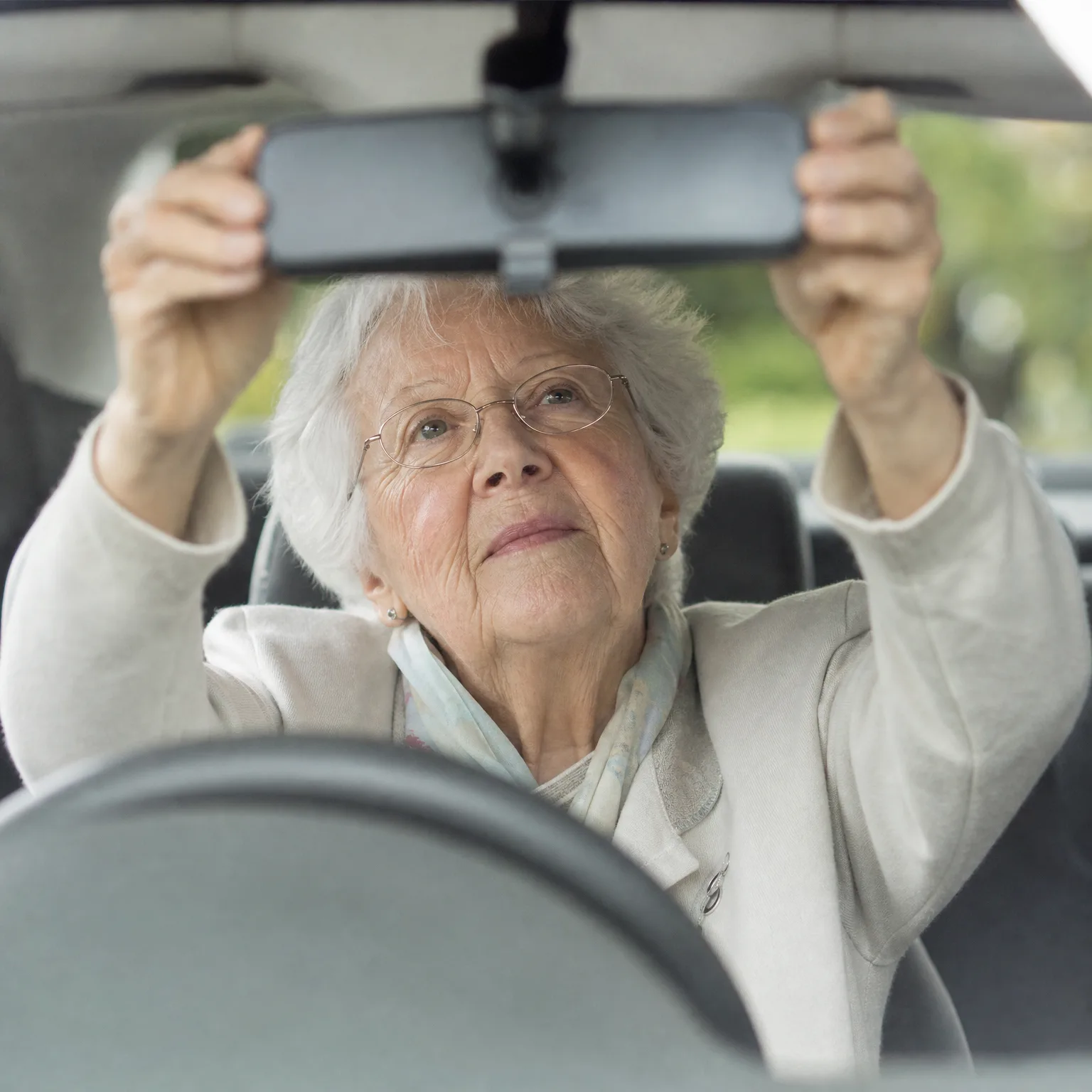
Illinois requires vision screening at every license renewal for drivers aged 75 and older. Standard renewal cycles run four years for most drivers, but drivers aged 81–86 renew every two years, and drivers 87 and older renew annually.
You cannot renew online or by mail after age 75. You must appear in person at a Secretary of State Driver Services facility or submit a Vision Report (Form VSD 1) completed and signed by a licensed ophthalmologist or optometrist within 90 days of your renewal date. The report certifies your corrected acuity and peripheral field measurements.
Missing your renewal window or failing to submit a current vision report results in automatic license suspension. Most carriers issue non-renewal notices or substantial rate increases when a policy renewal coincides with a lapsed license, even if the lapse lasts only a few days while you complete testing.

What Happens If Glaucoma Reduces Your Peripheral Vision Below 140 Degrees?
If your horizontal peripheral field measures below 140 degrees, Illinois will not issue an unrestricted license. The state may offer a restricted license requiring daylight-only driving, corrective lenses, or geographic limitations depending on the severity of field loss and your ophthalmologist's recommendation.
Drivers with field widths between 105 and 139 degrees often receive daylight-only restrictions. Field widths below 105 degrees typically result in license denial. These thresholds apply regardless of your central acuity — a driver with 20/20 corrected vision but 120-degree peripheral width will receive a restricted license.
Restricted licenses trigger different insurance responses depending on the carrier. State Farm, Country Financial, and Auto-Owners typically continue coverage with daylight restrictions but increase premiums 15–25% due to reduced driving privileges. Progressive and GEICO more frequently non-renew policies when restrictions appear, particularly for drivers over 80.
Do You Need to Notify Your Insurance Carrier About a Vision Restriction?
Illinois law does not require drivers to proactively notify their insurance carrier about vision restrictions, but your policy contract almost certainly does. Most carrier contracts include a clause requiring you to report any change in license status, including new restrictions, within 30 days of the change.
Failure to report a restriction gives the carrier grounds to deny a claim if the restriction is relevant to the accident circumstances. A daylight-only restriction violated by driving after sunset, for example, creates both a policy breach and a citation for driving outside restriction — either of which can void coverage for that incident.
Carriers receive electronic notification of license restrictions through state data exchanges, but the timing varies. Some receive updates within 10 days; others do not pull records until your policy renewal date. Reporting the restriction yourself before the carrier discovers it during a routine audit prevents the appearance of concealment and preserves your renewal eligibility with that carrier.

Find Coverage That Fits Driving Past 75
Compare Auto Insurance for Drivers 75+
How Do Vision Restrictions Affect Insurance Rates After Age 75?
Vision restrictions increase premiums primarily by signaling reduced driving capability, not the restriction itself. Carriers that continue coverage after a daylight-only restriction typically increase rates 10–30% depending on your prior rate class and claims history. Drivers already rated in a high-risk tier see smaller percentage increases than those previously in preferred tiers.
Carriers known to non-renew policies after vision restrictions include Progressive, GEICO, and Travelers, particularly for drivers over 80 with restrictions added mid-term. State Farm, Country Financial, Auto-Owners, and Nationwide more commonly continue coverage but move the policy to a standard or non-preferred rate class.
If your current carrier non-renews due to a vision restriction, you will need coverage from a non-standard carrier or the Illinois Automobile Insurance Plan (IAIP), the state's assigned risk pool. IAIP premiums run 40–70% higher than standard market rates for comparable coverage. A full-coverage policy costing $110/mo with a standard carrier may cost $180–210/mo through IAIP.

Should You Keep Full Coverage on Your Vehicle If You Receive a Vision Restriction?
Full coverage remains cost-justified if your vehicle is worth more than $8,000–$10,000 or if you drive more than 3,000 miles per year, even with a daylight-only restriction. Comprehensive coverage costs $15–$30/mo for most drivers over 75 in Illinois, and collision adds $40–$70/mo depending on vehicle value and your rate tier.
A daylight restriction does not reduce collision risk proportionally to the reduction in driving hours. Intersection accidents, backing incidents, and parking lot collisions — the most common claim types for drivers over 75 — occur primarily during daylight hours when errands and medical appointments are scheduled. Dropping collision to save $50/mo exposes you to the full replacement cost of a vehicle you are still using regularly.
If your vehicle is worth less than $5,000 and you drive fewer than 2,000 miles annually, liability-only coverage may make sense. Illinois requires $25,000 per person and $50,000 per accident in bodily injury liability, plus $20,000 in property damage liability. Minimum-limits liability policies cost $45–$75/mo for drivers over 75 with clean records, even with vision restrictions.
What Steps Reduce Insurance Costs After a Vision Restriction?
Complete an AARP Smart Driver course or AAA Safe Driving for Mature Operators course immediately after receiving a vision restriction. Illinois does not mandate these courses for restricted licenses, but most carriers offer 5–10% discounts for drivers who complete an approved program within 90 days of a restriction being added. The discount applies for three years and often offsets 30–50% of the rate increase caused by the restriction itself.
Reduce your annual mileage estimate to reflect actual driving patterns under the restriction. Drivers with daylight-only restrictions typically reduce annual mileage by 20–40% compared to unrestricted driving. Reporting a mileage reduction from 8,000 miles per year to 5,000 miles can lower premiums 8–15% with carriers that tier by mileage, including Progressive, Nationwide, and Allstate.
Request quotes from State Farm, Country Financial, and Auto-Owners if your current carrier non-renews. These three carriers write the majority of restricted-license policies in Illinois for drivers over 75 and price vision restrictions less aggressively than national carriers. Auto-Owners in particular writes policies for drivers with field widths as narrow as 110 degrees if central acuity remains strong and driving record is clean.
Frequently Asked Questions
Can I renew my Illinois license online after age 75 if I have glaucoma?
No. Illinois requires all drivers aged 75 and older to renew in person at a Secretary of State facility or submit a completed Vision Report (Form VSD 1) signed by an ophthalmologist or optometrist. Online and mail renewals are not available regardless of your vision condition or driving record.
Will my insurance company cancel my policy if I get a daylight-only restriction?
Not automatically, but non-renewal is common with certain carriers. Progressive, GEICO, and Travelers frequently non-renew policies when daylight restrictions are added for drivers over 80. State Farm, Country Financial, and Auto-Owners more often continue coverage but increase premiums 10–30%.
How long does a mature driver discount stay active after I complete the course?
Most Illinois carriers apply the mature driver course discount for three years from your completion date. You must retake an approved course every three years to maintain the discount. The discount typically reduces premiums 5–10% and can partially offset rate increases from vision restrictions.
Does Illinois require a road test if my glaucoma worsens and I get a vision restriction?
Illinois does not automatically require a road test when vision restrictions are added, but the Secretary of State may request a driving evaluation if your ophthalmologist's report indicates significant field loss or if you have recent traffic violations. Road tests are more commonly required when restrictions are added after age 80.
Related Articles

Glaucoma & Indiana License After 75: Vision Thresholds
4/29/2026

Glaucoma & Iowa License After 75: Vision Test Rules
4/29/2026

Glaucoma & CA License After 75: Vision Test Rules
4/29/2026

Glaucoma & Michigan License: Vision Rules for Age 75+
4/29/2026

Glaucoma & Florida License: Vision Tests at 75+
4/29/2026

Glaucoma & MA License: Vision Tests for Drivers 75+
4/29/2026